

Best Non-Alcoholic Shrub Soda Brands: 2026 Buyer's Guide
Table of Contents
- Quick Comparison: Top Shrub Soda Options
- How to Evaluate a Quality Shrub Soda Brand
- Drink Balo: Small-Batch Shrub Sodas and Mixers
- How to Make a Shrub Drink at Home
- Ready-to-Drink Shrub Mixers for Entertaining
- Shelf-Life and Storage Guidelines
- Pairing Shrub Sodas by Flavor Profile
- Frequently Asked Questions
Last Updated: September 12, 2026
Quick Comparison: Top Shrub Soda Options
Shrub soda is a carbonated soft drink built on drinking vinegar, fruit, and sugar, and it has become the most interesting category in zero-proof beverages. This guide from Drink Balo ranks the best non-alcoholic shrub soda brands by what actually matters: sugar load, vinegar quality, and whether the fruit tastes fresh or reconstituted. Most buyers fixate on flavor names, but the label's sugar line and ingredient sourcing decide whether a bottle is worth repeat buying.

Here is how the options in this guide stack up before we break each one down.
| Option | Format | Price | Sugar per Serving | Best For |
|---|---|---|---|---|
| Drink Balo 4-pack | 4 x 8.5 oz cans | $18.00 | 4 g cane sugar | First-time buyers |
| Drink Balo 6-pack | 6 x 8.5 oz cans | $27.00 | 4 g cane sugar | Weekly drinkers |
| Drink Balo 12-pack | 12 x 8.5 oz cans | $52.00 | 4 g cane sugar | Entertaining |
| Drink Balo shrub mixer | 16-18 drinks per bottle | $19.50 | 5 g per mixed drink | Home bartenders |
| Mass-market shrub cans | Varies | Varies | Often 10 g+ | Not recommended |
The pattern is hard to miss. Small-batch producers who ferment their own bases land in the 4-5 gram range. Bottlers who buy juice concentrate and add vinegar land far higher.
How to Evaluate a Quality Shrub Soda Brand
A quality shrub soda brand ferments or macerates its own fruit base, lists vinegar as a primary ingredient, and keeps added sugar low enough that the acidic profile still reads on the palate. Everything else is marketing.

Three checks separate the real producers from the blenders:
- Ingredient order. Fruit and vinegar should appear before sugar. If cane sugar or "natural flavors" leads the list, you are buying soda with a splash of vinegar.
- Vinegar type. Apple cider vinegar and balsamic reduction behave differently in a glass. Apple cider vinegar gives a sharp, clean bite; balsamic brings sweetness and body.
- Fermentation disclosure. Brands that ferment on site can tell you how. Brands that buy base liquid cannot.
What most guides miss is that a shrub is a preservation method before it is a drink. The vinegar is not a flavoring, it is the reason the fruit survives. When a producer treats it that way, the finished bottle tastes like fruit with a spine.
Sugar Content and Glycemic Impact
Sugar content is the fastest way to sort a shelf. A well-made shrub soda lands between 4 and 6 grams per serving, because the acidity does the work sweetness otherwise would (hsph.harvard.edu). Past roughly 10 grams, you are drinking a soft drink with vinegar notes.
Glycemic impact follows the same curve. Cane sugar in a 4-gram dose alongside vinegar produces a much gentler blood sugar response than a fruit-juice-sweetened can at triple the dose. Vinegar itself is widely studied for its effect on post-meal glucose response, and the Harvard T.H. Chan School of Public Health guidance on added sugars is clear that keeping added sugar low matters more than the specific type.
Read the label per serving, not per can. A 12-ounce can poured over ice and split between two glasses is two servings, and the math changes accordingly.
Sourcing and Vinegar Base Quality
Sourcing determines flavor more than any recipe step. A shrub built from fruit picked at peak ripeness and processed the same week tastes brighter than one built from juice concentrate, however good the formula looks on paper.
Vinegar base quality works the same way. Small-batch producers ferment their own or buy from regional makers, giving them control over acidity and residual sweetness; industrial bases are consistent but flat, and no botanical infusion hides that.
This is also where environmental choices show up. Fruit that would otherwise be discarded at market still carries full flavor, and redirecting it into a fermented base reduces food waste while keeping the ingredient list honest.
Drink Balo: Small-Batch Shrub Sodas and Mixers
Drink Balo ferments its own bases and processes whole fruit rather than buying juice. The company turns excess farmers market produce into naturally fermented shrub sodas and mixers, so the fruit is fresh, the supply shifts with the season, and every bottle supports local growers instead of a concentrate contract.
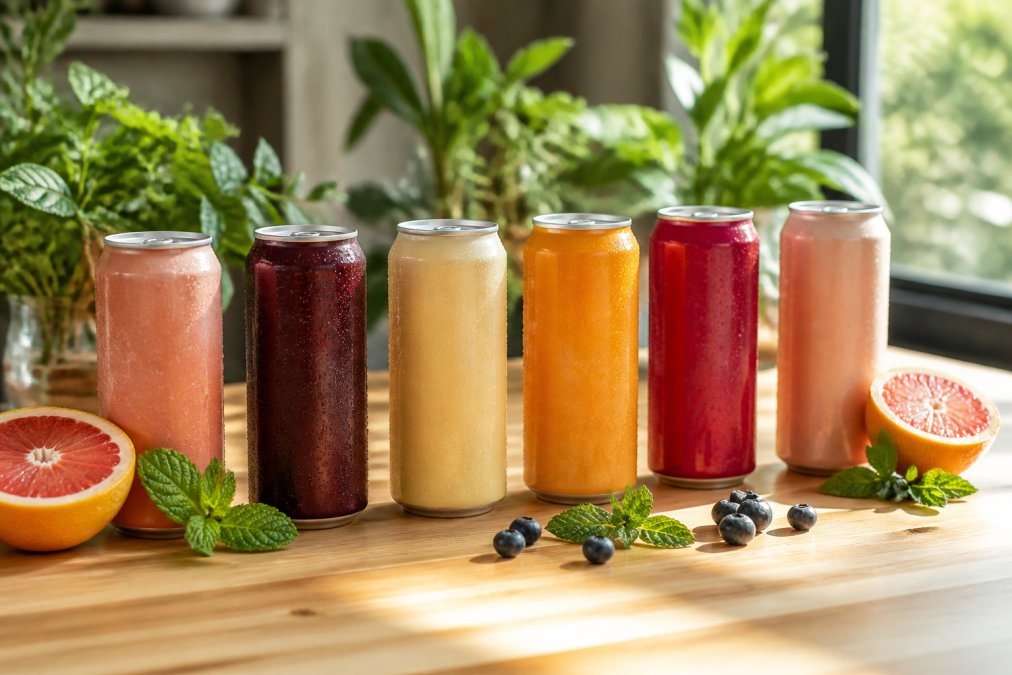
The lineup runs across two formats. Cans are ready to drink straight from the fridge at 8.5 ounces each, with 4 grams of cane sugar and a nine-month refrigerated shelf life. Mixers come in larger bottles that make roughly 16-18 drinks each when combined at one ounce of shrub to five ounces of sparkling water over ice, at 5 grams of cane sugar per mixed drink and six months of refrigerated life after opening.
Every product is non-alcoholic, naturally fermented, and carries adaptogenic and probiotic properties from the raw fermentation process. That is the difference customers ask about most: this is not juice with vinegar stirred in but a live fermented base, which is why the flavor has depth rather than a flat sweet-tart hit.
Flavor-by-Flavor Breakdown
Flavor is where small-batch production earns its keep. Each of these uses a different fruit and botanical pairing, and each lands differently depending on whether you drink it cold and neat or built into a spritz.
- Santa Rosa plum and grapefruit shrub soda, $18.00 for a 4-pack. Tart citrus up front, stone fruit underneath. The most food-friendly of the set, and the one to pour with a meal.
- Passionfruit and makrut lime shrub soda, $18.00 for a 4-pack. Bright, tropical, and sharply acidic. Makrut lime adds an herbal edge that keeps the passionfruit from tipping into candy territory.
- Blueberry, moringa, and yuzu shrub soda, $18.00 for a 4-pack. The most complex of the group. Yuzu brings citrus notes, moringa adds a green, earthy finish, and blueberry holds it together.
- Melon, satsuma, and mandarin shrub soda, $18.00 for a 4-pack. Soft and juicy, with the gentlest acidity in the lineup. The best entry point if you are new to drinking vinegar.
- Concord grape, lime, and guava leaf shrub soda, $18.00 for a 4-pack. Bold and grape-forward with a tart lime finish. Guava leaf gives it a tannic structure that reads almost like wine.
Buying in volume drops the per-can cost. The 6-pack runs $27.00 and the 12-pack runs $52.00, which is the format to choose if you are stocking a fridge for guests.

The mixers follow the same flavor logic in concentrated form. Blueberry, moringa, and yuzu; Santa Rosa plum and grapefruit; and passionfruit and lemongrass each run $19.50 per bottle and make roughly 16-18 drinks, a little over a dollar per serving, the strongest argument for the mixer format if you entertain often.
How to Make a Shrub Drink at Home
Making a shrub drink at home takes three ingredients and about two days of patience. The technique is maceration: coat fruit in sugar, let the sugar pull the juice out, then add vinegar and let the mixture rest.
Here is the working method:
- Combine fruit and sugar. Use roughly equal parts by weight, chopped fruit and cane sugar, in a clean jar. Stir to coat.
- Macerate for 24 hours. Cover and refrigerate. The sugar will dissolve into a syrup as it draws moisture from the fruit.
- Strain the syrup. Press the solids to get everything out, then discard the fruit or keep it for yogurt.
- Add vinegar. Stir in apple cider vinegar at roughly equal volume to the syrup. Taste and adjust.
- Rest for one to two weeks. Refrigerate and let the flavors marry. The sharpness softens noticeably.
- Build the drink. Mix one ounce of shrub syrup with five ounces of sparkling water over ice.
Two things go wrong most often: too much sugar, which flattens the acidic profile, and skipping the resting period, which leaves the vinegar raw and harsh. The rest is not optional.
Fruit-based syrup made this way keeps for months in the refrigerator because the vinegar acts as a preservative. That is the whole point of the format.
Ready-to-Drink Shrub Mixers for Entertaining
Ready-to-drink shrub mixers solve the one problem that keeps people from serving shrubs at parties: nobody wants to batch syrup while guests are arriving. A bottled mixer lets you pour one ounce, top with five ounces of sparkling water, add ice, and hand it over.
The economics favor this format for groups. A single $19.50 bottle of Drink Balo mixer yields roughly 16-18 drinks, so a host serving a dozen people needs one bottle and a case of sparkling water, the mixer wins on both cost and counter space.
For a zero-proof bar setup, keep three things on hand:
- One or two shrub mixers in contrasting profiles, one citrus-forward and one berry-forward
- Sparkling water and tonic water as the two mixers that work with almost any acidic base
- Garnishes that echo the fruit in the bottle: citrus wheels, fresh herbs, whole berries
A spritz built on tonic water instead of plain sparkling water picks up quinine bitterness, which plays well against a sweeter shrub like the melon and mandarin. Club soda is the neutral choice when you want the fruit to lead.
Shelf-Life and Storage Guidelines
Shrub soda storage comes down to two numbers: keep it cold, and know your format's clock. Unopened cans hold nine months refrigerated; opened mixer bottles hold six months, unusually long for a fresh-fruit product and a direct result of the vinegar's preservation effect.
The rules that matter:
- Refrigerate everything, always. These are raw fermented products with live cultures. Warm storage shortens shelf life and can restart fermentation.
- Cans are sealed until opened. Once a can is open, drink it the same day. Carbonation and flavor both fade fast.
- Mixers are the flexible format. A bottle stays good for six months after opening in the fridge, so you can pour a single drink without committing to the rest.
- Watch for change, not dates. A little sediment is normal in a raw fermented product. Off aromas or a sharp shift in taste are the signal to discard.
This is the gap most buying guides skip, and it matters more than flavor for anyone ordering regularly: a format you cannot store properly is a format you will waste.
Pairing Shrub Sodas by Flavor Profile
Pairing a shrub soda is about matching acidity to richness: the sharper the drink, the heavier the food it can cut through. Get that right and a zero-proof drink holds its own at the table.
Working pairings by profile:
- Citrus-forward, high acid (Santa Rosa plum and grapefruit, passionfruit and makrut lime). Pair with fried food, rich cheeses, and anything with fat that needs cutting.
- Berry-forward, medium acid (blueberry, moringa, yuzu; Concord grape, lime, and guava leaf). Pair with roasted meats, aged cheese, and dark chocolate.
- Soft and juicy, low acid (melon, satsuma, and mandarin). Pair with salads, light seafood, and brunch dishes. This is also the profile to serve to someone trying drinking vinegar for the first time.
For a non-alcoholic pairing with spirits alternatives, the logic applies in reverse. A botanical, gin-style zero-proof spirit needs a citrus-forward shrub to keep the drink from tasting muddy; a smoky or barrel-aged alternative wants the berry profiles, which have enough structure to stand beside it.
For anyone exploring zero-proof options more broadly, the NIH guidance on alcohol and health is worth reading before you decide what belongs in your glass.
The hardest part of buying shrub soda is not finding a bottle, it is finding one that ferments its own base instead of blending juice and vinegar. Most of the shelf is the second kind, which is why sugar counts run high and flavors taste thin. Drink Balo builds the first kind: raw fermented bases made from excess farmers market produce, 4 grams of cane sugar per can, naturally fermented with probiotic and adaptogenic properties, and a mixer format that stretches a single $19.50 bottle into 16-18 drinks. Start with the 6-pack at $27.00 to find your flavor, then move to the 12-pack at $52.00 when you know what you like. Add to cart and taste what a real shrub is supposed to be.
Frequently Asked Questions
What is a shrub soda?
A shrub soda is a carbonated drink made from a shrub, which is a vinegar-based syrup that combines fruit, sugar, and vinegar. The mixture is often fermented or macerated to develop complex flavors. When mixed with sparkling water, it creates a tart, sweet, and refreshing non-alcoholic beverage. Shrub sodas are part of the growing zero-proof movement, offering a sophisticated alternative to cocktails without the alcohol.
Are shrub sodas healthy?
Shrub sodas can be a healthier alternative to sugary sodas and alcoholic drinks, especially when made with natural ingredients and low sugar. Many brands use organic fruit and raw vinegar, which may support digestive health. However, sugar content varies widely. Look for options with 5 grams of sugar or less per serving, like Drink Balo's shrub sodas, which have 4 grams of cane sugar per 8.5 oz can.
What does a shrub drink taste like?
A shrub drink tastes tart, sweet, and slightly acidic, with the vinegar providing a tangy backbone that balances the fruit's natural sweetness. The flavor depends on the fruit and any added herbs or spices. For example, a plum and grapefruit shrub is bright and citrusy, while a blueberry and yuzu shrub is more floral and complex. The vinegar is present but not overwhelming, especially when mixed with sparkling water.
Can you drink shrub mixers straight?
Shrub mixers are concentrated, so drinking them straight is not recommended. They are designed to be mixed with sparkling water, club soda, or tonic water, typically in a 1:5 ratio. For instance, Drink Balo suggests mixing 1 oz of shrub mixer with 5 oz of sparkling water and ice. This dilution balances the tartness and creates a refreshing, ready-to-drink shrub soda.
How do you serve a non-alcoholic shrub soda?
Serve shrub soda chilled, over ice in a glass, and garnish with fresh fruit, herbs, or a citrus twist. For a more festive presentation, add a sprig of mint or a slice of lime. If using a shrub mixer, combine 1 oz of mixer with 5 oz of sparkling water. You can also use shrub soda as a base for zero-proof cocktails by adding non-alcoholic spirits or bitters.