

How Long Does Kombucha Stay Fresh? A 2026 Storage Guide
Table of Contents
- How Long Does Kombucha Stay Fresh? The Short Answer
- Refrigerated Kombucha Shelf Life: Unopened vs. Opened
- Signs of Spoiled Kombucha: What to Look, Smell, and Taste For
- Proper Kombucha Storage Temperature: Why the Fridge Matters
- Store-Bought vs. Homemade: Why Shelf Life Differs
- How Packaging and Handling Affect Freshness
- Frequently Asked Questions
Last Updated: September 10, 2026
How Long Does Kombucha Stay Fresh? The Short Answer
Kombucha stays fresh for about 3 to 5 days after you open it, and up to several months sealed and refrigerated (foodsafety.gov). That gap is the key to how long does kombucha stay fresh, because the clock starts the moment air hits the liquid. At Drink Balo, we ferment raw kombucha in small batches and label every bottle with a 9-month refrigerated window. Below, we'll show you how to read a best-by date, spot real spoilage, and store bottles so the last pour tastes as good as the first.

Three variables decide the answer: whether the seal is broken, how cold your fridge runs, and whether the kombucha is raw or pasteurized.
| State of the Bottle | Refrigerated Shelf Life | What Changes |
|---|---|---|
| Unopened, raw | Up to 9 months | Slow continued fermentation |
| Unopened, pasteurized | Best-by date, often 6-12 months | Minimal change |
| Opened | 3 to 5 days | Carbonation fades, acidity rises |
| Opened, homemade | 1 to 3 days | Faster souring, more yeast activity |
Refrigerated Kombucha Shelf Life: Unopened vs. Opened
Refrigerated kombucha shelf life splits into two phases, and treating them as one number is where most people go wrong: an unopened bottle is a sealed ecosystem, an opened bottle an active one.
Unopened Bottles: What the Best By Date Really Means
A best-by date is a quality marker, not a safety cliff, it guarantees flavor, carbonation, and probiotic character, not that the bottle turns dangerous at midnight. Raw kombucha keeps fermenting slowly in the fridge, so a bottle that sat for months tastes sharper and fizzier than a fresh one. Pasteurized bottles last longer because heat stops microbial activity, but they lose the live cultures. If a sealed, refrigerated bottle is a few weeks past its date, smell and taste it before pouring it out.
After Opening: The 3 to 5 Day Window
Once you break the seal, oxygen gets in: carbonation escapes, the liquid oxidizes, and the vinegar taste intensifies. Most opened bottles are best within 3 to 5 days; homemade kombucha, with a more active culture and no preservative buffer, can turn noticeably sour in 1 to 3 days. Cap it tightly, keep it cold, and pour into a glass rather than drinking from the bottle.
Signs of Spoiled Kombucha: What to Look, Smell, and Taste For
Signs of spoiled kombucha show up in a predictable order: appearance, then smell, then taste. Checking in that sequence catches problems before you drink them.
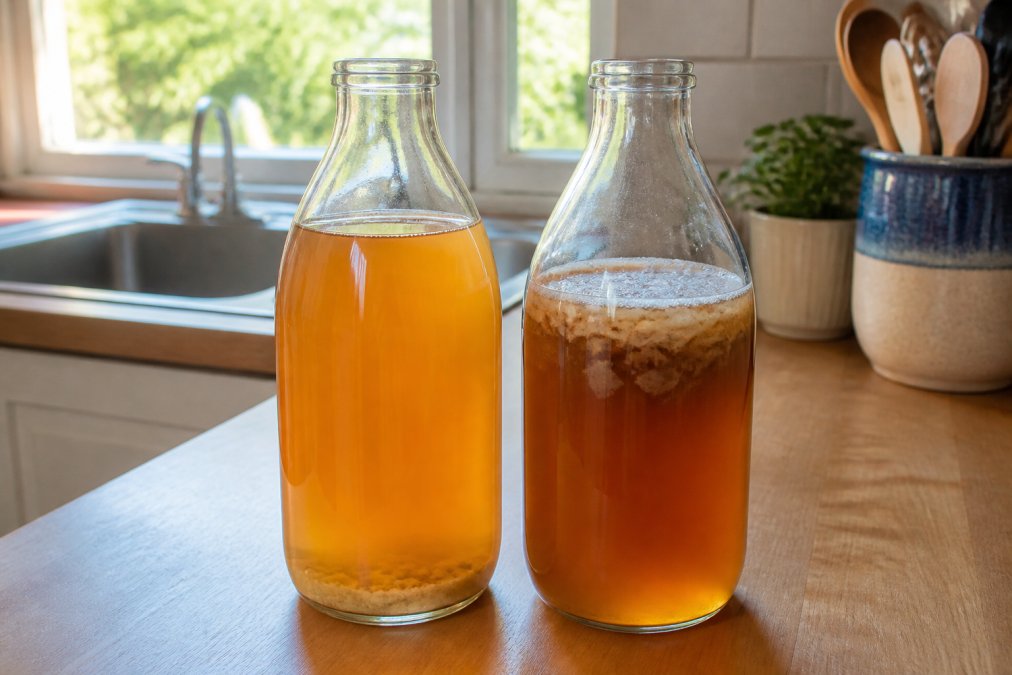
Normal Sediment vs. Dangerous Mold
Yeast strands and sediment signal a healthy, living culture, not a defect. Thin, stringy wisps suspended in the liquid or a fine layer at the bottom are spent yeast, harmless, and why raw kombucha looks different from bottle to bottle.
Mold is different: it grows on the surface, appears dry or fuzzy, and shows up in patches of white, green, blue, or black (usda.gov). If the growth is fuzzy or hairy rather than stringy, discard the bottle. Discoloration that spreads in patches, an off-smell like rotten vinegar or damp basement, and a sharply bitter taste all point the same direction. Never skim mold off the top and drink the rest.
Proper Kombucha Storage Temperature: Why the Fridge Matters
Proper kombucha storage temperature is the difference between a drink that holds its character for months and one that turns in days. Refrigeration slows fermentation without stopping it; warmth speeds the culture up, drives carbonation, and pushes the liquid toward vinegar.
What Temperature Range Actually Works
A standard home fridge runs between 35°F and 40°F, the sweet spot for kombucha (the FDA). Below 35°F you risk freezing the liquid near the back wall, which can damage the culture and crack glass; above 40°F, fermentation speeds up noticeably, a bottle at 50°F sours and carbonates faster than one at 38°F. A cheap refrigerator thermometer next to your bottles tells you more than the dial does.
Placement Inside the Fridge
Keep bottles at the back of the fridge, where temperature stays most consistent, not in the door where it swings every time you open it. Keep them upright so the cap seal stays clean and sediment settles predictably, and leave a little space between bottles so cold air circulates.
Normal Sediment vs. Dangerous Mold: A Visual Guide
Kombucha is a living product, so some visual change is normal. Here is how to separate healthy sediment from actual mold growth:
- Normal yeast strands: thin, stringy wisps in the liquid, or a fine tan-to-brown layer at the bottom, spent yeast, harmless, and expected in raw kombucha.
- Normal sediment: a cloudy haze or a little dark, tea-like particulate, a sign of a living, unfiltered brew.
- Mold: grows on the surface, dry or fuzzy, in patches of white, green, blue, or black. If it is fuzzy or hairy rather than stringy, discard the bottle.
- Pellicle fragments: a small, rubbery, translucent film or chunk is SCOBY or a new pellicle forming. Safe, though some strain it out.
When Room Temperature Is Acceptable
Room temperature is fine in one case: a sealed bottle you plan to drink within a day or two, or one you are intentionally carbonating further. Home brewers leave sealed bottles out for a day or two to build carbonation before refrigerating, bottle conditioning. Beyond that, warmth works against you: a bottle left out overnight won't make you sick, but it tastes sharper, fizzier, and less balanced than one that stayed cold.
Store-Bought vs. Homemade: Why Shelf Life Differs
Store-bought and homemade kombucha age at different rates. Commercial raw kombucha is brewed in controlled conditions, bottled with consistent sugar, and refrigerated from the moment it is sealed. Homemade varies every batch: sugar content, brewing cycle length, and SCOBY health all shift the timeline.
A few practical differences matter most:
- Pasteurized store-bought is shelf-stable and lasts longest, but contains no live probiotics.
- Raw store-bought keeps for months sealed and days opened, and stays alive the whole time.
- Homemade is the most active and the least predictable, often best within 1 to 3 days of opening.
- Sugar level drives how fast the culture keeps working; a drier, less sweet brew sours more slowly.
If you brew at home, bottling into glass with a tight seal gives you more control: glass holds an airtight seal best, plastic is slightly permeable to oxygen, and cans protect from light but can't be resealed. A can is a single sitting, not a bottle you nurse for a week.
How Packaging and Handling Affect Freshness
Packaging and handling decide how much of that shelf life you actually get. The container is the barrier between a living, carbonated, acidic liquid and the air around it, and three variables matter: oxygen permeability, light transmission, and resealability.
Glass vs. Plastic vs. Cans: What Each Container Does to Freshness
- Glass offers the tightest seal and lowest oxygen transmission. Amber or dark glass also blocks ultraviolet light that degrades flavor compounds. The trade-off is weight and breakage risk, and it only protects the liquid while the cap is tight.
- Plastic (PET) is lighter and shatter-resistant, but slightly permeable to oxygen and carbon dioxide. A bottle that sits for weeks slowly loses carbonation and tastes flatter than the same brew in glass. For a few days, the difference is negligible; for long-term storage, glass wins.
- Cans block light completely and retain carbonation while sealed, but cannot be resealed. Once you crack one, the clock is the same 3-to-5-day opened window with no cap to slow it down. If you don't finish it, transfer the remainder to a small glass jar with a tight lid and refrigerate immediately.
Back-Washing: The Contamination Risk Most Guides Skip
Drinking directly from the bottle, back-washing, introduces saliva into the liquid. Oral bacteria don't belong in a fermenting, acidic environment, and they accelerate spoilage, cloud the liquid, and flatten carbonation. A bottle that would have held up five days can go flat and funky in two after a single sip from the rim. Pour into a glass, and if you want to save the rest, cap the bottle immediately and refrigerate it.
Light, Heat, and the Trip Home
Light degrades kombucha's compounds, so amber or opaque glass protects flavor better than clear glass on a sunny shelf, and an airtight seal keeps oxygen out and carbonation in. Handling matters too: leaving a bottle in a hot car can undo weeks of cold storage in an afternoon, a sealed bottle that reaches 90°F or higher for an hour or two ferments faster, builds pressure, and tastes sharper. If you're stocking up, bring a cooler bag or buy your kombucha last.
Freezing: Why It Is Not a Long-Term Storage Fix
Freezing is a common question from home brewers, and the answer is usually no. Water expands as it freezes, which can crack glass bottles or split plastic seams. More importantly, the freeze-thaw cycle damages the living culture: the yeast and bacteria don't survive intact, and thawed kombucha separates, tastes flat, and loses its carbonation. To slow a bottle for a few weeks, use the fridge; to stop fermentation entirely, only pasteurization does that, a decision made before the bottle reaches you.
Frequently Asked Questions
How long does kombucha stay fresh after opening the bottle?
Once you open a bottle of kombucha, it stays fresh for about 3 to 5 days in the refrigerator. The live cultures continue fermenting, so the taste gets tangier and more vinegar-like over time. Carbonation fades fastest in the first 24 hours. To keep it at its best, reseal tightly and return it to the fridge immediately after each pour. If it develops an off-smell or fuzzy spots, discard it.
What are the signs of spoiled kombucha?
Signs of spoiled kombucha include fuzzy patches of mold on the surface, a sharp vinegar or rotten smell, and a taste that has turned unpleasantly sour. Normal kombucha may have stringy yeast strands or sediment, which are harmless. Mold is always a sign to throw the bottle out. If the liquid has become thick or syrupy, that also points to spoilage. Trust your senses: if it smells wrong, don't drink it.
Does raw kombucha need to be refrigerated at all times?
Yes, raw kombucha should stay refrigerated at all times. Proper kombucha storage temperature is between 38°F and 45°F. At room temperature, the live cultures keep fermenting, which quickly turns the drink sour and can lead to spoilage. Brief transport at room temperature is fine, but for daily storage, the fridge is essential. This is especially true for unpasteurized brands like Drink Balo's raw kombucha, which contain active probiotics.
Can you freeze kombucha to make it last longer?
Freezing kombucha is not recommended. The freezing process can kill the beneficial probiotics and alter the texture, leaving the drink flat and separated. If you must freeze it, leave headspace in the bottle because liquid expands and glass can crack. For best quality, stick to refrigeration and drink within the recommended window. If you have extra bottles, share them or use them in dressings and marinades instead of freezing.