

How to Reduce Food Waste: Hacks That Actually Work
Table of Contents
- Why Reducing Food Waste Starts with What You Buy
- Meal Planning for Zero Waste: A Weekly System That Works
- How to Store Produce to Last Longer
- Creative Ways to Use Vegetable Scraps
- Food Preservation Hacks to Reduce Food Waste Long-Term
- Composting and the Psychology of Food Waste
- How Shrub Mixers Help You Reduce Food Waste at Home
- Conclusion
Last Updated: August 18, 2026
Food waste is one of the most solvable problems in any household, yet most people tackle it the wrong way. At Drink Balo, we think about food waste every day, our entire model is built on transforming excess farmers market produce into fermented shrub mixers rather than letting it rot. The habits that guide a zero-waste kitchen are the same ones that make home cooking more satisfying, more affordable, and significantly more sustainable.
According to USDA Economic Research Service food loss data, food loss and waste represents roughly a third of the food supply at the retail and consumer levels. The good news: most of it is preventable with the right workflows.
Why Reducing Food Waste Starts with What You Buy
The biggest mistake most people make happens before they even open the refrigerator. They shop without a plan, buy more than they can realistically eat, and then wonder why the crisper drawer becomes a graveyard.
Build a Grocery List That Actually Reflects What You'll Eat
A grocery list should map directly to specific meals you intend to cook that week, accounting for how many people you are feeding and how many nights you will actually cook at home. Before writing a single item, audit your refrigerator and pantry. Plan meals around perishable goods you already have. Buy whole vegetables rather than pre-cut versions, they last significantly longer. Resist bulk buying on produce unless you have a concrete plan to freeze or preserve the excess.
The real challenge is sticking to your list at the store, where marketing displays are specifically designed to encourage impulse purchases of perishable goods you will not finish.
FIFO: The Inventory Rotation Habit That Eliminates Forgotten Food
FIFO stands for first-in, first-out. When you unpack new groceries, move older items to the front of the shelf or drawer and place newer purchases behind them. You always reach for the oldest item first. Most food spoilage at home happens not because people forget they have food, but because they consistently grab the newest, freshest-looking item and let the older one expire in the back. Apply FIFO to the refrigerator, pantry, and freezer.
Meal Planning for Zero Waste: A Weekly System That Works
Meal planning for zero waste is not about rigid schedules. It is about building a flexible system that accounts for real life, the nights you order in, the lunch you eat at your desk, the produce that ripens faster than expected.
Batch Cooking and Portion Management
Batch cooking is the practice of preparing large quantities of a base ingredient once or twice a week and using it across multiple meals. Roast a full sheet pan of vegetables on Sunday. Cook a large pot of grains. Braise a big cut of meat. From those three components, you can assemble different meals throughout the week without anything going to waste. Calibrate batch sizes to your actual household consumption, not to some idealized version of how much you think you should eat.
| Strategy | Best For | Waste Reduction Impact |
|---|---|---|
| Batch cooking grains and proteins | Weekly meal prep | High, eliminates daily over-cooking |
| FIFO rotation | Pantry and fridge management | High, prevents forgotten food |
| Airtight sealing | Produce and leftovers | Medium-High, extends shelf life |
| Stock bags for scraps | Root-to-stem cooking | Medium, turns waste into ingredients |
| Freezing excess produce | Seasonal gluts | High, extends produce longevity indefinitely |
Digital Inventory Management: Track What You Own Before You Shop
Maintain a running list in a notes app or dedicated pantry-tracking app of what you have in your refrigerator, freezer, and pantry. Before you shop, check the list. When you buy something new, add it. When you use something up, remove it. This takes about three minutes per week once established. The payoff is that you stop buying duplicates and forget about perishable goods before they turn.
How to Store Produce to Last Longer
Proper food storage is where most households lose the most produce. The difference between a bunch of herbs that lasts two days and one that lasts two weeks comes down almost entirely to how you store it.
Airtight Sealing and Humidity Control
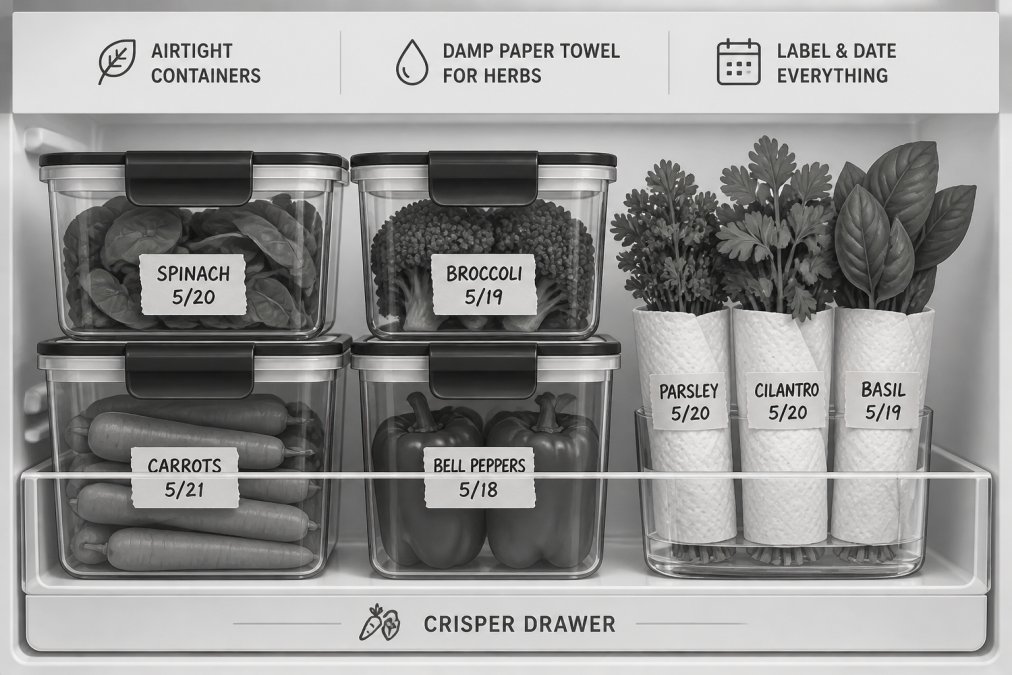
Produce longevity is governed by two factors: moisture and ethylene gas. Airtight sealing slows moisture loss and limits exposure to ethylene, a natural gas that accelerates ripening and spoilage. Leafy greens need high humidity, store them in a sealed container with a slightly damp paper towel. Onions, garlic, and potatoes need low humidity and air circulation; keep them out of the refrigerator entirely.
A few storage rules that make a real difference:
- Wrap fresh herbs in a damp paper towel and stand them upright in a jar with an inch of water, loosely covered with a bag. They will last up to two weeks.
- Store berries unwashed in a single layer on a paper towel in an open container. Wash only before eating.
- Keep avocados at room temperature until ripe, then move them to the refrigerator to extend their window by several days.
- Separate bananas from the bunch; the connection point releases concentrated ethylene.
Understanding Expiration Labels: Use-By vs. Best-By vs. Sell-By
Expiration labels in the United States are largely unregulated and inconsistently applied. According to FDA guidance on food product dating, only infant formula is required by federal law to carry a use-by date. Every other label, sell-by, best-by, best before, is a manufacturer's estimate of peak quality, not a safety cutoff.
Use-by: The manufacturer's recommended date for peak quality. Most foods are safe to eat after this date if stored correctly.
Best-by / Best-before: A quality indicator, not a safety indicator. The food may taste slightly different but is not necessarily unsafe.
Sell-by: Intended for retailers, not consumers. Food is typically safe to eat for several days to weeks after this date.
Use your senses: if it smells off, looks wrong, or has visible mold, discard it. If it looks and smells fine, it almost certainly is.
Creative Ways to Use Vegetable Scraps
The scraps most people throw away are genuinely useful ingredients. Carrot tops, celery leaves, broccoli stems, corn cobs, onion skins, herb stems, these are not garbage. They are flavor.
Stock Bags and Bone Broth: Zero-Waste Kitchen Staples
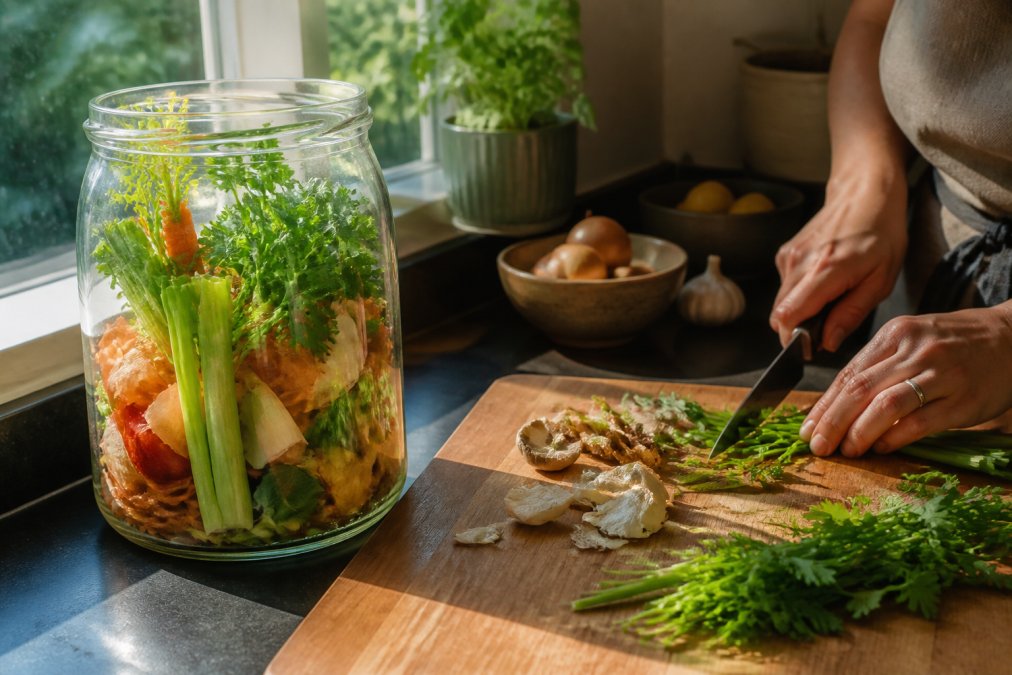
A stock bag is a zip-lock or reusable bag in the freezer where you collect vegetable scraps over time: onion skins, leek tops, carrot peels, celery ends, mushroom stems, corn cobs, herb stems. When the bag is full, cover the scraps with water in a large pot, simmer for 45 to 60 minutes, strain, and you have deeply flavored vegetable stock. Zero additional cost. Zero waste.
Bone broth follows the same logic. Save bones from roasted chicken or beef, freeze them until you have enough, then simmer with your vegetable scraps and a splash of apple cider vinegar for several hours. The result is a mineral-rich broth that costs almost nothing and uses ingredients that would otherwise be discarded.
Root-to-Stem Recipes You Can Make This Week
Root-to-stem cooking uses every part of a vegetable, from root to leaf:
- Broccoli stems: Peel the tough outer layer and slice the interior thinly. Sauté with garlic and olive oil, or shave raw into slaws.
- Carrot tops: Blend with olive oil, garlic, lemon, and nuts to make a pesto.
- Watermelon rind: Pickle it with rice vinegar, sugar, and chili flake.
- Corn cobs: Simmer in water for 30 minutes to make naturally sweet corn stock.
- Citrus peels: Candy them, dry them for tea, or use them to make shrub mixers.
Food Preservation Hacks to Reduce Food Waste Long-Term
Food preservation is the long game of waste reduction. When you have more produce than you can eat fresh, preservation extends its usable life from days to months.
Pickling and Fermenting Excess Produce
Pickling is the fastest preservation method available to a home cook. A basic quick pickle requires vinegar, water, salt, and sugar in roughly equal parts by volume, heated until dissolved and poured over vegetables in a jar. Cucumbers, radishes, red onion, green beans, jalapeños, almost any firm vegetable can be quick-pickled and will keep in the refrigerator for several weeks.
Lacto-fermentation goes further. Vegetables fermented in a salt brine develop complex flavor and produce live cultures that support gut health. Sauerkraut, kimchi, and fermented carrots are straightforward starting points.
Dehydrating and Freezing: Cost-Benefit Breakdown
Freezing is the lower-barrier option. Almost any vegetable can be blanched and frozen for months. Fruit freezes without blanching. The main cost is freezer space and electricity. Airtight sealing before freezing is non-negotiable to prevent freezer burn.
Dehydrating requires either a food dehydrator or an oven set to its lowest temperature. The upfront cost ranges from modest to significant, but operating costs are low and results keep at room temperature for months to years. According to National Center for Home Food Preservation guidelines, proper dehydration reduces moisture content enough to prevent microbial growth without refrigeration.
For most households, freezing handles the bulk of preservation needs. Dehydrating is worth the investment if you regularly deal with large quantities of produce or shop at farmers markets where seasonal abundance is common.
Composting and the Psychology of Food Waste
Composting is the right answer for food scraps that genuinely cannot be eaten or preserved. A basic backyard compost bin or countertop collector diverts organic material from landfill and returns nutrients to soil. It is not a substitute for reducing waste, it is the last resort in a hierarchy that starts with eating food before it spoils.
Most food waste at home is not caused by ignorance. The gap between intention and behavior is usually one of friction: the produce is in a drawer out of sight, leftovers require reheating, scraps feel like too little to do anything with. Reducing waste is fundamentally about designing your kitchen environment to make the right choice the easy choice. Keep produce visible. Store leftovers at eye level. Keep your stock bag accessible in the freezer door.
Mindful consumption is not a personality trait. It is a set of systems. Build the systems and the behavior follows.
How Shrub Mixers Help You Reduce Food Waste at Home
Shrub mixers are concentrated drinking vinegars made by combining fruit, sugar, and vinegar. They are one of the oldest food preservation techniques in American culinary history and an elegant solution to excess produce.
When you have citrus that is starting to dry out, stone fruit that is overripe, or berries that are one day from turning, those are ideal candidates for a shrub. The sugar draws out the juice, the vinegar preserves it, and the result is a concentrated mixer that keeps for months and makes a sophisticated non-alcoholic drink in seconds, one ounce of shrub to five ounces of sparkling water over ice.
Drink Balo's shrub mixers take this concept to a commercial scale, using excess farmers market produce that would otherwise be discarded. The Blueberry, Moringa & Yuzu Shrub Mixer, Santa Rosa Plum Grapefruit Shrub Mixer, Passionfruit & Lemongrass Shrub Mixer, and Concord Grape, Lime & Guava Leaf Shrub Mixer are each priced at $19.50 and yield 16 to 18 drinks per bottle, just over a dollar per drink for something genuinely complex, fermented, and built on produce that would otherwise be wasted.


Making your own shrubs at home is worth trying with fruit you have on hand. But for consistent quality, seasonal variety, and the satisfaction of supporting local growers, a bottle from Drink Balo is the shortcut that aligns with every value this guide has covered.
Reducing food waste at home is not a single action. It is a collection of interlocking habits: smarter shopping, proper storage, creative use of scraps, and preservation when you have more than you can eat fresh. If you want a ready-made product that embodies the zero-waste philosophy, Drink Balo's shrub mixers are made from surplus farmers market produce, fermented for flavor and function, and designed for people who want a sophisticated, non-alcoholic drink without the waste. Add to cart and see what a difference it makes, in your glass and in your kitchen.
Frequently Asked Questions
What is the 2-2-2 rule for storing leftovers safely?
The 2-2-2 rule is a food safety guideline: refrigerate leftovers within 2 hours of cooking, store them for no more than 2 days in the fridge, and reheat to an internal temperature of at least 165°F before eating. Following this rule prevents bacterial growth in perishable goods and reduces the risk of foodborne illness, while also encouraging you to actually use leftovers rather than letting them sit forgotten at the back of the fridge.
What is the difference between 'use-by' and 'best-by' dates?
A 'use-by' date is a food safety marker, eating the product after that date carries a real health risk, especially for meat, dairy, and ready-to-eat meals. A 'best-by' or 'best-before' date is a quality indicator set by the manufacturer, meaning the food is still safe to eat after that date but may have declined in flavor or texture. Misreading best-by dates as expiration dates is one of the biggest drivers of unnecessary household food waste.
How can I properly store produce to extend its shelf life?
Keep ethylene-producing fruits like apples and bananas separate from vegetables, since ethylene gas speeds up ripening and spoilage in nearby produce. Store leafy greens wrapped in a slightly damp paper towel inside an airtight container. Root vegetables do best in a cool, dark spot rather than the fridge. Most herbs stay fresh longer standing upright in a small glass of water, loosely covered. Airtight sealing is the single biggest factor in extending produce longevity across almost every category.
What are the best ways to repurpose vegetable scraps?
The most practical approach is keeping a stock bag in your freezer, toss in onion skins, carrot peels, celery ends, and herb stems as you cook, then simmer everything into vegetable stock when the bag is full. Citrus peels can be dried and used as zest or infused into vinegar for cleaning. Beet greens, broccoli stems, and carrot tops are all edible and work well sautéed or blended into sauces. Root-to-stem cooking turns scraps into meals rather than waste.
This article was written using GrandRanker